
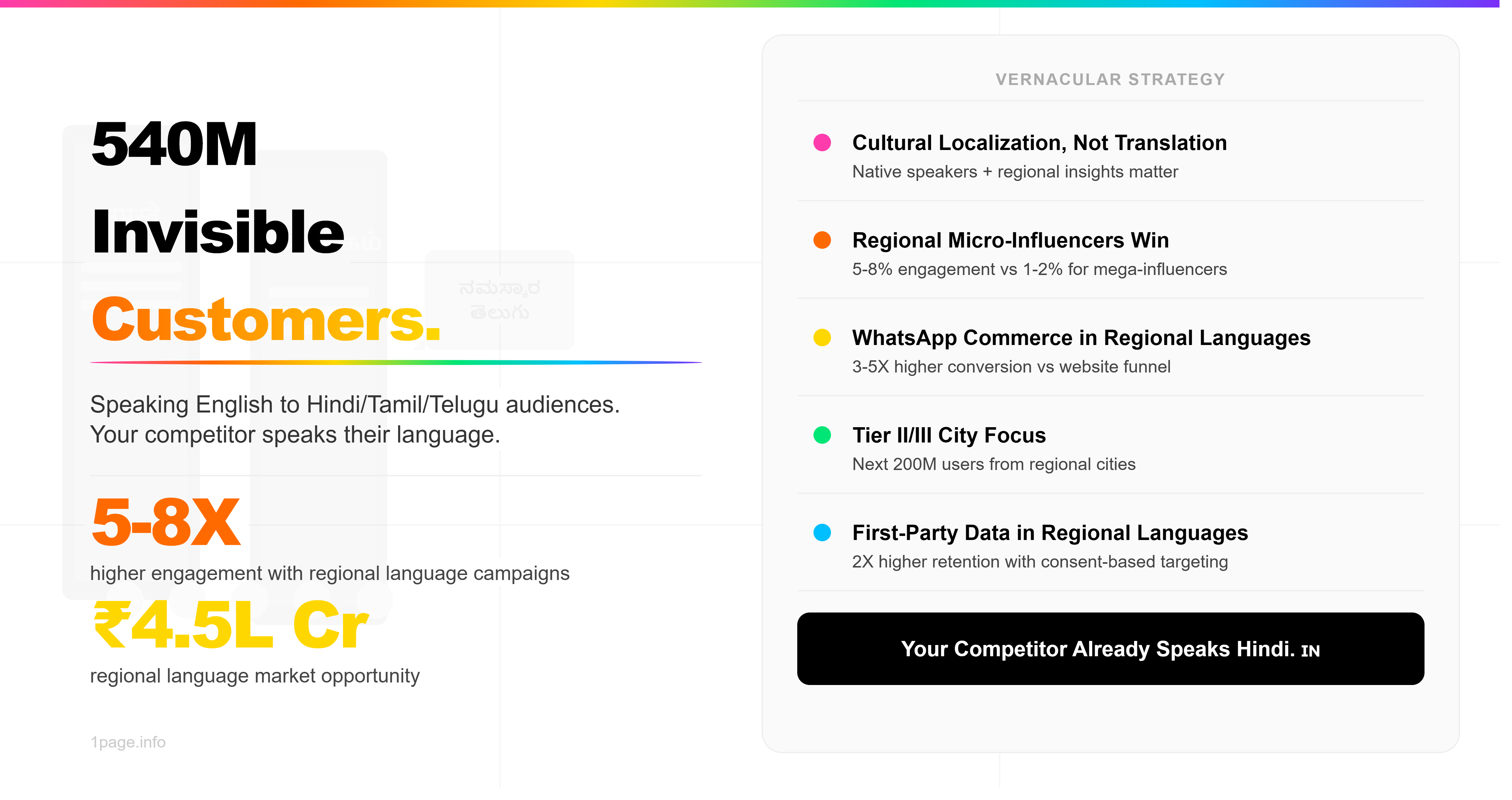
Your brand is invisible to 540 million Indians.
Not because your product is bad. Not because your ads don't run. But because you're talking to them in English.
In 2026, 73% of India's internet users consume content in regional languages — Hindi, Tamil, Telugu, Kannada, Bengali, Marathi, Gujarati. These are not small niche audiences. This is a ₹4.5 lakh crore market opportunity that most brands haven't even noticed yet.
The brands winning right now are not the ones with the biggest budgets. They're the ones that cracked regional language marketing.
India's Digital Marketing Playbook Just Split Into Two
For the last decade, if you wanted to scale a brand in India, you did one thing: English marketing. Run ads on Google. Post on Instagram. Build your website in English. Assume that English-speaking India was the market.
In 2026, that assumption is costing you customers.
The structural shift is simple: India's next 200 million internet users are not coming from metros. They're coming from Tier II and Tier III cities. And they consume content primarily in regional languages.
Not as a preference. As a primary behavior.
A customer in Pune might understand English. But when they search for "best laptop" they search in Marathi. When they watch YouTube they watch Marathi creators. When they see an Instagram ad they're more likely to click if it's in Marathi. When they chat on WhatsApp they speak Marathi.
Your English ad reaches them. They scroll past. Your competitor's Marathi ad appears. They stop. They click. They buy.
The Scale of the Opportunity
540 million Indians consume content primarily in regional languages. That's not a footnote. That's larger than the entire population of the United States.
The ₹4.5 lakh crore market opportunity is not hypothetical. It's already happening. Brands that entered regional language marketing in 2024-2025 are now seeing 5-8X higher engagement rates compared to their English campaigns.
A fintech app running campaigns in Hindi, Telugu, and Kannada is acquiring customers at 40-50% lower cost per acquisition than competitors running English-only campaigns. Why? Because they're meeting customers where they already are — in their language.
Regional language content is growing faster than English on every platform. On YouTube, regional language creators are growing 3X faster than English creators. On Instagram, regional language hashtags see 4X more engagement. On TikTok, regional language videos dominate. On Facebook, regional language groups have 10X more active members than English groups.
The data is unambiguous. But most brands are still ignoring it.
Why English-Only Marketing Fails in Bharat
There's a misconception that regional language marketing is "extra." That it's a premium feature brands add after their English strategy is mature.
The opposite is true. English-only marketing is now a liability in Tier II and Tier III cities.
Here's why: when you run an English ad to someone whose native language is Telugu, you're asking them to mentally translate. That friction costs you. A customer that would have clicked an English ad has already scrolled past. By the time they process what you said, your competitor's Telugu ad has already converted them.
But there's a deeper issue. Language is not neutral. It's a signal of respect. When a brand speaks to you in your language, you feel seen. When they speak to you in a foreign language, you feel like an afterthought.
A customer in a small town in Haryana will buy from a brand that speaks Hindi to them. They will trust it more. They will recommend it to friends. They will become an advocate.
A brand that speaks to them only in English will always feel distant.
The Localization Trap
Here's where many brands get it wrong: they think vernacular marketing is translation.
They take their English ad, run it through Google Translate into Hindi, and call it a day.
This doesn't work. Regional language marketing requires cultural localization, not just translation.
A fintech app's English tagline might be "Build Your Wealth." The Hindi version can't just be "Apni Dhan Banao." It has to be culturally resonant. It might be "Apne Sapne Ka Ghar Banao" (Build Your Dream Home) — because in Hindi-speaking India, buying a home is the primary wealth goal.
The same campaign run across India requires different messaging for different regions. A campaign about building wealth in Karnataka should reference "Bangalore's tech boom." In Kerala it should reference "Gulf remittances." In Punjab it should reference "farming success stories."
Real vernacular marketing requires native speakers. It requires understanding regional culture, regional aspirations, regional pain points. You can't do this with a translation tool.
Brands getting this right are seeing 2-3X higher conversion rates compared to generic regional marketing.
The Micro-Influencer Advantage
One of the biggest discoveries in 2026 is that regional language micro-influencers outperform mega-influencers dramatically.
A mega-influencer with 1 million followers might see 1-2% engagement on an English post. A micro-influencer with 50,000 followers speaking regional language might see 5-8% engagement on a regional post.
Why? Because the micro-influencer is embedded in the community. They speak the language. They understand local jokes, local festivals, local pain points. Their followers trust them because they feel authentic.
Brands that shifted budgets from 2-3 mega-influencers to 30-50 regional micro-influencers are seeing acquisition costs drop by 40-50%. And the quality of customers is higher because they come from micro-communities that already trust the influencer.
The operational challenge is scale. Managing 50 micro-influencers is harder than managing 1 mega-influencer. But that's why AI automation is solving this problem in 2026. Voice agents now handle creator discovery, onboarding, and compliance, reducing campaign launch timelines from weeks to days.
The WhatsApp Commerce Play
WhatsApp has quietly become a commerce platform. And regional language brands have figured out how to use it.
Click-to-WhatsApp ads let you put an offer directly in front of a customer. They click. They land in WhatsApp. They see your catalog. They buy. All within WhatsApp.
For Tier II/III customers, this is perfect. They already live on WhatsApp. They already speak their regional language on WhatsApp. Moving them to an external website or mobile app feels like friction.
Brands running regional language WhatsApp commerce are seeing 3-5X higher conversion rates compared to traditional website funnels. Why? Because the customer never leaves WhatsApp. The entire experience is in their language. It feels native.
The Data Privacy Advantage
India's Digital Personal Data Protection Act is forcing brands to get first-party data consent. Most brands see this as a restriction.
Smart brands see it as an opportunity.
When you ask someone "What language would you like to receive marketing in?" most people say their regional language. When you ask "Do you want product recommendations?" many regional language users say yes because they trust you're speaking to them respectfully.
First-party data collected with explicit consent is more reliable, more stable, and builds more trust. Brands that built first-party data infrastructure focused on regional language preferences are now seeing 2X higher retention rates.
What Needs to Happen Now
If your brand is still running English-only campaigns to Tier II and Tier III cities, you're leaving money on the table.
Here's what smart brands are doing:
First, audit your customer base by language. If 50% of your users are in Hindi-speaking regions, you need a Hindi strategy. If 30% are Telugu-speaking, you need a Telugu strategy.
Second, hire native speakers. Don't translate. Create original campaigns in each language with people who understand the culture.
Third, invest in regional language creators. Not mega-influencers. Micro-influencers with 20K-50K engaged followers in each language region.
Fourth, localize your product experience. Your app should support regional languages. Your customer service should be available in regional languages. Your ads should be culturally specific, not globally generic.
Fifth, measure differently. English and regional language campaigns will have different metrics. Don't compare them directly. Instead, optimize each for its own audience.
The Bottom Line
540 million Indians consume regional language content. They're buying products. They're signing up for apps. They're becoming loyal customers.
The question is whether they're becoming your customers or your competitor's customers.
The brands winning in 2026 are not the ones with the biggest ad budgets. They're the ones that cracked the code of speaking to customers in their language, their culture, their way.
English marketing in India reached its ceiling in 2024. The next growth wave is regional. The next 200 million customers speak Hindi, Tamil, Telugu, Kannada, Bengali, Marathi, Gujarati.
Your brand needs to speak their language to reach them.